2017 Trip 2: urban camping

Trip 2: Rouge River Park - May 2017

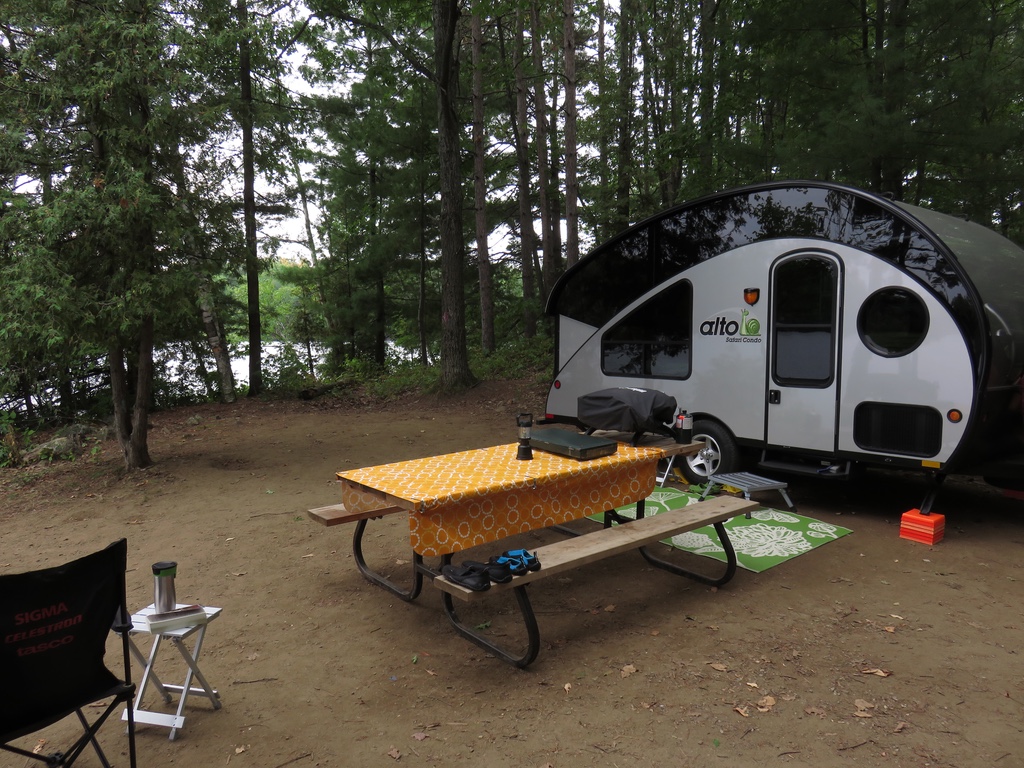
We were very excited for this extended long week trip. We headed to the Rouge River campground, a municipal park in Toronto. It is on the lower west side of Pickering, on the Rouge River.

This river stretches from Lake Ontario to north of Toronto. It is a huge swath of green space, that is currently being transformed into a national urban park by Parks Canada, and will be the first in Canada with this designation. The park spans 80 square kilometres in the heart of Canada's largest city. By comparison, it will be 22 times larger than Central Park in New York.

2017 Trip 1: de-winterizing 101

Trip 1: Cedar Cove Resort - May 2017

It seems that as soon as we put the Alto into storage in the fall, we start to plan, and pine, for the next season to begin. This planning is a nice distraction from our generally crappy winters, which some years can certainly drag on. It is also the time where I ponder the new mods I want to do, researching and refining how to go about each that I think of, including whether it is really of any value.

We spent the past week slowly placing our gear back inside. Although over the winter we leave a bunch of stuff in the Alto, there is an assortment that does come out and heads for the basement. By now, a lot of this activity is on autopilot, we have had the Alto long enough that the outfitting plan has few surprises remaining.

Cedar Cove once again, and this weekend, Jenn & Chris were here, as well as brand new owners Donna & Wayne. All of us de-winterizing and getting everything sorted for another summer of camping. The forecast was calling for rain, and sure enough it did rain all weekend. There were a few hours here and there where the sky broke, but only a few.


Jenn & Chris were just finishing setting up when we arrived, and Donna & Wayne arrived around 8:30. We got them squared away, then we all piled into our Alto for appetizers and a visit.


As we had flushed out the antifreeze and then bleached our tanks overnight, Saturday was all about rinsing the tanks and other odds & sods. This year I used baking soda in the final rinse to help remove the bleach smell, and I do think it made a difference. We also checked to make sure everything in the Alto survived the winter and was working as it should. We all then helped Donna & Wayne get their Alto de-winterized and ready. Lots of new gizmos in their latest version of the Alto, so it was neat exploring the new gear. Spot the changes is a little game that I think most of us play in our minds whenever we are in someone else's camper.

As the weather was still ugly, we had late afternoon appetizers over in Jenn & Chris Alto, and sampled a brew from their Aero-press coffee maker (nice full flavour) and then we headed over to the restaurant for dinner...a nice bonus with this campsite. They have a good creative menu, nice surroundings, and the beer was cold. Lots more visiting, sharing Alto tales, upcoming road trips, and plenty of laughs.


The sun was out for a tiny bit on Sunday morning, but only long enough to fool me into thinking that I could get a few extra minutes of drying time for the awning and ground mat. And fool it did. I turned my back for a minute and the skies opened up again, giving everything another good soaking. It did stop later, and we were soon all outside, starting to get things ready to pack up and head out. There was lots of learning and helping each other out going on this weekend.

Although the weather may not have cooperated, having fellow Alto campers together, all excited about the new camping season, our conversations and many laughs filled the days, the weather soon faded into the background. It was fantastic having company and I suspect this may well become a regular happening.

2016 Trip 12: down to the last out...

Trip 12: Cedar Cove - Oct 2016

We headed to Cedar Cove this afternoon, our traditional spot to winterize the Alto and close out the camping season. Cedar Cove is a nice private campground, that is quite close to Ottawa. Although it is mostly a seasonal campground, the overnight sites are close to the water, fully serviced, and they also have a good restaurant. This gives you some options if you just don't feel like cranking up the Q and getting a dinner together. The weather was co-operating, a bit of a drizzle on Friday evening, but on the whole, pretty good. There was a large trailer on a site across from us, and the couple were lounging outside listening to the Jays game. He gave me a quick update on the game thus far, and I listened as we set up. There is something quite special about a ball game on the radio. It is always a pleasure to follow a baseball game over the radio, better than other sports. I think it has to do with the pace of the game, the strategy, the stats, the announcers...this all seems to lend to the feeling that you could actually be at the game, instead listening over the airwaves. Fellow Alto owners, Chris & Jennifer also arrived Friday with their 1743, and once we were all set up, we got together for a beverage and quick catch-up. This was their first season, and they are closing up this weekend as well.

It was nice having electricity, as the temperatures dropped into the low 30'sF overnight, so our various sources of heat got a good workout. Actually, this is only the second time we have electrics this season, the first being when we opened up back in May, at this very site. Our reliance on serviced sites has dropped way off over the years, as we slowly settled into our style of camping. As well, our trend to favour waterfront sites usually negates any chance of services. Interesting how things evolve, our camping style shaped by the experiences we most want to enjoy.

Coffee on the Coleman in the morning was definitely a brisk wake-up event. Even still, it is a great way to start the day, as usually you are out there alone, surveying and taking in all around you. There were others awake at this time, it is hunting season, and the faraway sounds of shotguns occasionally broke the morning quiet. Dale and Barley were still well tucked in under the covers when the coffee made its way back into the camper. It was a very relaxing day, a nice power walk, poked around the Alto, read a bit, grabbed a quick nap.  I also made a few notes on potential winter projects for the Alto, something I seem to do every closing weekend. Later in the afternoon we walked over to Chris & Jenn's for a pre dinner beverage and appies.

2016 Trip 11: boys weekend

Trip 11: Bonnechere P.P. - Sept 2016

Headed out at noon, wanting to get a bit of a head start on my "boys weekend". Now before your mind conjures up images of beer cans, hot dogs and bonfires, it will be pretty tame as there are only two of us, and for the record, the other guy has four legs! Yup, Barley and I are spending some quality time together this weekend.


2016 Trip 10: a simple relaxing weekend

Sharbot Lake P.P. - Sept 2016

Back to Sharbot Lake, on the primo site we had last time we were here. Only goes to prove that a little planning can sure help in snagging a great site. Now that September is upon us, the finality of our short camping season has descended upon us. Knowing that this is one of the last times out, our trips become less of an adventure, and more of just getting out there...to soak up the last of the fresh air and natural surroundings.


looking for a little breeze...

So it is a Sunday afternoon and I have just finished a little outside repair on the house. I've got an assortment of tools in my bucket, including my drill and bits, so naturally, I'm wondering if there is anything else that needs to be done...and naturally, my gaze fell upon the Alto.

We were sitting at Sandbanks this summer, soaking up a beautiful, although stinking hot day, when it struck me that there was really not a lot of natural air circulation in our Alto. This can be helped by running the fan, but glancing around at the screened openings, it is pretty limited. This is certainly the case when compared to the 1743 model, which has very large opening on all sides, so the breezes must be wonderful. Our particular vintage also has the original metal back window, that incorporates a narrow screened band at the bottom, rather than the newer plastic window that can be opened to expose a large ventilation area.

While I was sitting at the front table, sweating, I started to look closely at the screened part of the door, wondering how to increase that surface area. As we have Barley with us, we still need the option to make sure he stays indoors, which means the door must be closed. This sort of precludes the full screen door mods that are out there, as I know Barley could blow right through those if his desire was strong enough.  At times we have been putting him on his leash and opening the door, but as a rule, it is usually closed. Not many options to do anything that would yield a big improvement, but I did notice a possibility for a minor change.

Our window slides open and is held in place by a plastic clip, which is attached to an aluminum cross bar. There did not seem to be any reason why the window would not slide open a little higher, based on the frame design. The limiting factor is when the frame starts to curve at the top. The cross bar is held in place by two small rivets, which are easily drilled out. I also pondered whether this cross bar contributed to the structural integrity of the window itself, and I came to the conclusion that it did not. There is a joint to the track part of the window frame, slightly below the cross bar, but it has its own linking plate. 


note the position of the cross bar and the amount of glass covering the screen
As this bar will be moving up into the area where the window frame starts to curve around the top, this means that the bar itself needs to be modified. Doing this then negates any possibility of reversing the mod, should it not work, or worse yet, if I screw up the measurements. Given the vintage of the window, and that they are no longer even made like this, if I did screw up, I strongly suspect there would no way that SC could bail you out with a new piece. One must remember this before starting a mod. Always have a Plan B in mind to fix a mod that might not work, or goes horribly off the rails.

I carefully drilled the rivets, and off came the bar.  The window was raised to almost its maximum height, and the bar was marked for its new location on the frame. A small piece was cut off each end to fit the curve of the frame, then new holes drilled for the rivets. A quick install of the rivets, and we were good to go. I applied a bit of black paint here and there, and other than the old rivet holes that are now visible, it certainly looks like this is the way it came out of the factory.


2016 Trip 9: Rollins...always great!

Rollins Pond S.P. - Aug 2016

Off to Rollins for a week vacation, the second part of splitting our two weeks of vacation this summer. We tried something a little different on this Rollins trip, as we usually head down Friday morning, and use it as our travel day. Throw in the stops we make for a little shopping in Ogdensburg and then groceries in Tupper Lake, and the Friday is pretty much shot by the time we make it to the park. Dale dropped an idea a few days before we left about heading down earlier after work on Thursday instead, and here comes the change, stay overnight in the Ogdensburg Walmart parking lot. That is generally our first stop anyways, so why not camp there? Shop in the evening, then hit the road in the morning?  It made perfect sense, so that's exactly what we did.

one could almost call this quaint...

Solar Upgrade Part 3: a 12 volt audit

When one gets a new gizmo, there is a strong tendency to gravitate towards using it all the time...it's only natural. I would have to say that the Trimetric has had a bit of this effect on me...I just have to press that little button to open up the new world of information it has to offer. This is not a bad thing mind you, I have a much better understanding of what is going on with the state of our solar/battery setup than I ever did before.

Once I got past the fascination with the raw data, it was time to put it to use to figure out exactly what each 12 volt device in the Alto costs, in terms of impact to the battery. Energy conservation while off grid is a bit of a pursuit of ours, so knowing what the real loads are will be great. So I began an energy audit, and along the way, learned a little bit more about how some devices actually work.

First I put together a list of the devices that run on 12 volts, or have a 12 volt component in their operation, such as the 2-way fridge. It may be propane and electric, but the overall operation is controlled by a 12 volt circuit board. Same goes for the water heater. There are a surprising number on board, 19 unique devices in our Alto, not double counting any of the similar light fixtures.  Once I had the list, I then set about to determine the amp hour draw of each one.  This involved turning devices on one at a time, and recording the draw as measured by the Trimetric.

With the display off, the draw of the Trimetric is .01 amp/hr. This came right from the spec sheet, as with no display, how would you get this info? With the display on, the draw is .03 amp/hr. This became the phantom draw to be removed from each reading taken. Next up were the detectors, of which our Alto has the two separate units, LP & CO. As they are both on the same circuit, it was easy to find the combined draw. I might add that all this detective work was done well after darkness had fallen. I wanted to completely eliminate any residual power generation from the solar panels.  The amp/hr calculations done by the Trimetric are based on what is going in & out of the battery. If there is a bit of solar amps going in, then the reading of a device’s draw will be skewed by this positive value. This also fluctuates, as the Trimetric is sensitive enough to pick up the solar output changes caused by even a tiny little cloud.  After dark, I know the readings are truly for the device draw, with no other influences.

From there, it was just a matter of putting the various devices into use one at a time, and watching the Trimetric calculate the negative impact on the battery. Pretty straight forward stuff, or so I thought. I had assumed that once the detectors were on, that was the draw. Not so. While I was finding the draw for one of the LED lights, I saw the amp display move from a stable value, and jump up a fair bit.  There was nothing else on, other than the detectors, so it was a tad puzzling. A bit later, the draw dropped back down to what it was when the light went on.  I turned the light on and off, and monitored the draw further...sure enough, up it jumped again. I timed the on/off cycles. It was soon clear that one of the detectors was "sniffing" the air on a regular 1 minute on, 1 minute off cycle. Based on this, the phantom draw of the detectors was certainly more than I first recorded, and you would be surprised how this changes the calculations over a 24 hour period. The fridge has a cycle as well. There is the control board, and then when the fridge is called upon to cool, there is a little solenoid that opens to allow the propane to flow for the cycle. Holding that solenoid opens makes up the bulk of the draw, and needs to be factored into the amp/hr cost.

Once everything was mapped, I created a little spreadsheet (of course) that would calculate the draw of each device, over different periods of time. Anything with a phantom draw as well as a functioning draw is calculated over a 24  hour period, and this required some adjustments to blend the amp/hr rate. Yes...this is all very geeky.

The chart is pretty interesting, especially when you start to play with the amount of time that a device is running in a day. Take the water pump, a huge amp hog, but then look at how long it actually runs in a day. Even including the possibility of a Dale outdoor shower, would that pump run 10 minutes, 15 perhaps, in a day. This works out to about 1 amp/hr a day. Now look at those little detectors, no motor in them, yet over the 24 hours they are on, they eat over 3 amp/hrs! Now who is the power hog??? But that's not to say those are not worthwhile amps, and certainly not going to try to save any there.

When trying to figure out just how many amps were being used in a day, I think there are a couple of groups, what I call the driveway and camping core draws. These are consumptions that are just simply going to be there, regardless. The driveway consists of the Trimetric and the detectors, and over a 24 hour period, adds up to over 3 amp/hrs. I've heard some people pull the fuse on their detectors at times, but I'm just not comfortable with that, even if it is just simply sitting there, waiting for the next adventure.  The core camping draw are the same devices, but adds in the fridge and water pump. If you are out, you are pretty much using these, and they are pulling amps out of the battery. I'm sure you could find some savings if you are able to adjust the temp of the fridge, or even turn it off, but for the sake of not getting too crazy with the calculations, I'm assuming a relatively normal manner of operations.

From there, I used this core group and came up with a couple of scenarios, to try and estimate just how much we may be using. These definitely lean towards conservative consumption. You can see how it could be very easy to use up all your available amp hours, as devices go on, it add up quickly. If you are out for a while off grid, you also have to keep in mind that you need to replace the amps you take out, and this requires good solar conditions...which means lots of sunlight. As well, from what I have read, the amp hours come out of a battery a lot easier than they get replaced, which is probably the main reason I upgraded the solar controller, to make sure this process was as effective as it could be.

So after a few outings with the new solar components, am I satisfied it has been a good investment? Most definitely! Not only do I know exactly what is coming and going from the battery, I know that the battery is being charged as effectively as possible. Can I quantify this. I think so. The battery recovers its charge a little faster, from the parameters programmed in it is certainly fully charged, and when I initiate an equalization phase, I know I am prolonging the overall battery life as per Trojan specs. Sounds pretty good to me.

I would certainly recommend the additional of a Trimetric monitor for those planning on a lot of off grid camping. It really helps you know exactly what the battery state of charge is.

Have a look over the chart, and although some of the equipment in the Alto has changed over the years, it will give you a high level picture of how amp hour usage can accumulate over the course of a day, and how your own camping style will impact this.  The raw numbers are there to help you calculate your own scenarios. Pretty interesting stuff.


Item Device Phantom
Draw
Amp
Draw
Approx
Mins
Day
Approx
Hrs
Day
Daily
A/hrs
Notes
1Trimetric
(display off)
0.0100.010144024.000.240
2Trimetric
(display on)
0.030300.500.015
3LP/CO detectors
(individual units,
same circuit)
0.09
(0.18 sniffing)
0.135144024.003.240- one detector sniffs for
1 minute,
then phantom for
1 minute
- amps prorated
over 24 hrs
4Fridge
(Dometic
2-way propane)
0.07
(0.32 cooling)
0.284144024.006.816- estimates fridge cools approx. 40 min/hr
 -amps prorated
over 24hrs
5Fridge Vent Fan
(single 50CFM fan)
0.1703005.000.850- only used during
hot weather
6Water Heater
(Suburban propane)
0.750300.500.375- morning/evening
cycles
7Furnace
(Propex propane)
2.1701803.006.510- morning/evening
occasional cycles
8Water Pump5.630100.170.938
9Roof fan
(setting 1)
0.9601803.002.880
10Roof fan
(setting 2)
1.4901202.002.980
11Roof fan
(setting 3)
2.240000- rarely used
12Roof lifts6.03010.020.101
13Bench lift1.16010.020.019
14Light fixture
(single LED
tube retrofit)
0.420601.000.420- Luci lights factor
into all lighting estimations
15Light fixture
(double LED
tube retrofit)
0.910- rarely used
16LED strip
(front cabinet,
dimmer low)
0.030601.000.030
17LED strip
(front cabinet, dimmer high)
0.270
18LED strip
(sink)
0.150300.500.075
19LED strip
(ceiling ambient)
0.220601.000.220
20Exterior light
(incandescent)
0.930- rarely used
21TV
(tv mode)
0.050
22TV
(dvd mode)
0.0501.7501202.003.50
23Tank monitor0.13020.030.004
24Fantastic fan
(portable,
setting 1)
1.3301803.003.990
25Fantastic fan
(portable,
setting 2)
1.980
26Fantastic fan
(portable,
setting 3)
2.760
27Tivoli
(radio charging)

28Core draw
(driveway)
0.145144024.003.480- items: 1, 3
- amps prorated
over 24hrs
29Core draw
(camping)
0.429144024.0011.234- items: 1, 3, 4, 8
- amps prorated
over 24hrs
30Cool day scenario18.644- items: 6, 7, 14,
16, 18, 29
31Hot day scenario22.834- items: 5, 6, 9, 10,
14, 16, 18, 24,
25, 29
32Conserving day scenario 14.114- items: 9, 29

2016 Trip 8: The Hip...Canada's band

Sharbot Lake PP - Aug 2016

Let's just start by saying that our little blurb about camping this weekend pales in comparison to what happened Saturday evening in Kingston...the end of The Tragically Hip's tour, and the last concert they will ever play.  An emotional tour for both the band and its fans, who were stunned by the announcement  in May that Gord Downie has terminal brain cancer. A poignant end to a 30 year musical journey that over the years created a soundtrack of Canadiana. It was an amazing and emotionally charged evening, the entire country watching, enjoying, and saying thanks for being Canada's band for so many years.

Headed out after work, the traffic is surprisingly light for a summer Friday evening. Made great time to the Park, got registered and then made our way to the site. We were able to reserve what may be the nicest waterfront site in the Park. It is a good size, level, and with lots of privacy. Well tucked in from the road, and although a bit of a challenge with a sharp downward turn from the road, once again, going slow and taking your time proves we can place the Alto pretty much anywhere.


2016 Trip 7: a beach bum vacation

Sandbanks PP - Aug 2016

Friday
Headed down to Sandbanks this morning to start one week of vacation. One of our favourite locations, Sandbanks is apparently the largest freshwater sandbar and dunes in the world!  The hot weather has continued in Ottawa, so we figure Lake Ontario should be nice and warm for swimming.