Showing posts with label Brakes. Show all posts

Brake Controller Replacement

I suspected this one was about to happen. Since I replaced the brake assemblies at the start of the season, and perhaps even before that, the braking of the Alto just seemed to be a bit off. I first thought the brake shoes needed further adjusting, but that made no difference. The magnets were buzzing, so they were getting power, and given the adjustment attention the shoes were getting, the next possible cause was the controller.


Wheel Assembly Replacement...a bit of a job

What started out as a straight forward replacement and repacking of the bearings, soon turned into a far larger job. This became immediately apparent as soon as I laid my eyes on the inside surfaces of the drum. Before I go any further, please take a moment and read my little disclaimer.

Another Bearing Repack

Once again it is time to pull apart the hubs and clean and repack the bearings. At the same time, I give the brakes a good cleaning. It's a pretty straight forward job, but it does take a bit of time, as you have to jack up the Alto, pull everything apart, clean and repack, then put it all together again. I imagine at some point I will just have it done somewhere, but until that time comes, it will be one of those spring jobs I do.

I noticed there was a fair amoint of brake dust on the inside of the rims, so I suspect I have been re-adjusting the shoes perhaps a tad to close. This time I will make a point of leaving them backed off just a little bit more. I can always give them a fine tune if I find the electric brakes are not grabbing enough. Once I got the hubs off, everything looked pretty good. The grease is still bright blue, with no sign of discolouring of that icky milky consistancy when water has started to get mixed in.

Gave the drums and the shoes a good cleaning, then pulled the back seal, cleaned both the bearings, had a real close look for any pitting or excessive heat scorching, but all looked good. Repacked the bearings, greased up the races, then put the hubs back on. Tightened up as per the Dexter Service Manual, and we were done. Checked the brake adjustment, then headed over and did the other side.


front bearing ready to go...

a lot cleaner now...and still in real good shape

I'm rotating the tires, so the service side tire now becomes the spare. The inside of the rims were in bad need of cleaning to get rid of the brake dust, but afterwards, they looked great. Getting the spare tire back in place was probably the part of the process thst I was least looking forward to. The way it hangs under the tongue is a very nifty setup, but a serious pain in the ass to re-install. There had to be a simpler way to do this other than brute effort. After staring at it a bit, which is an activity that has always served me well in the past, I figured that whatever method used to help the process had to utilize gear that would be with us at all times.

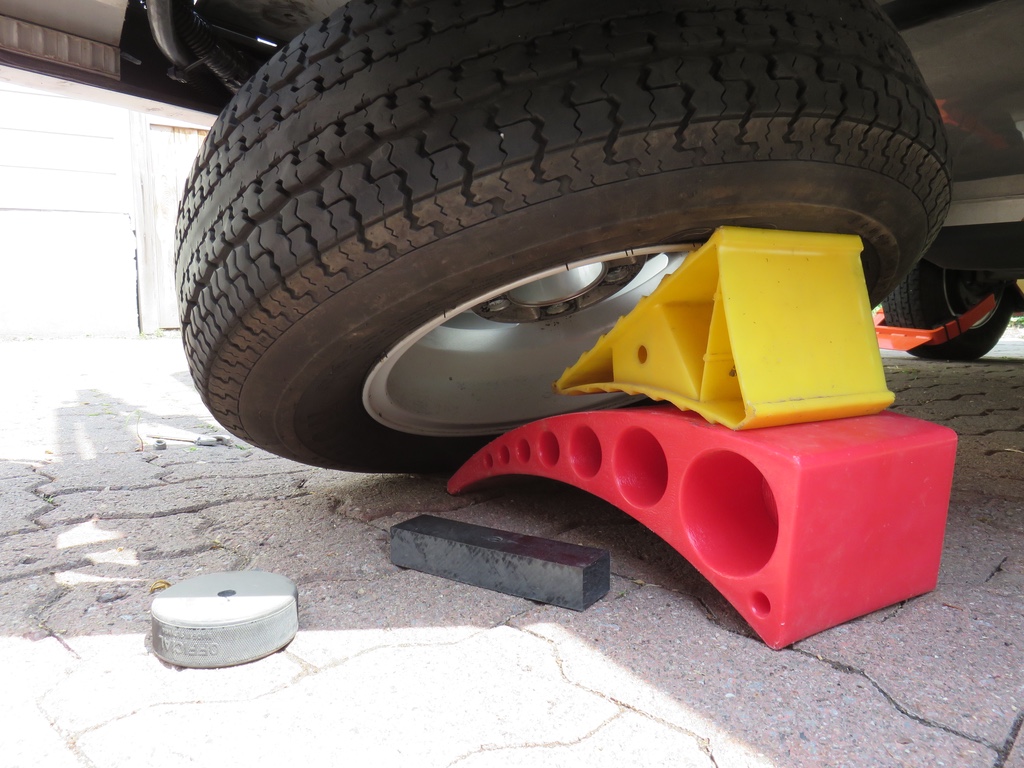
Looking in the trunk, I spied the Anderson Levellor, and the wheel chocks. I figured if I could get one side propped up high enough, it would be easy to just raise the other side and start threading on the support bar. Sure enough, I was able to use the levellor and chock to get the one side almost totally in place, then I easily lifted the other side up, held it in place with my knee, then secured the whole thing. Easy peasy.

works like a charm

I think we could probably go three years between repacks, based a lot on the current yearly milage we do. Will we go the three years, hard to say. It is nice to know that the bearings are in good shape.

Wheel Bearing Repack

Last year when I cleaned the brakes, the bearing grease looked pretty good. It only had one season of miles on it at that point, and the grease was still bright blue. I figured they were still good for another season. I ordered some new bearing and seals from Dexter, not only in prep for the upcoming repack job, but also to keep on hand. From the research I have done, wheeel bearing and seals appear to be any trailer's Achilles heel. Not sure why, it just is. My first thought is this is due to lack of... you guessed it, maintenance.

I figured out the brand of grease used on the bearings, Kendall Super Blue, found a supplier in Ottawa, and got some for the repack job. I found a great number of vids available on You Tube that provided step by step instructions and lots of practicle tips on how to do the job. Watching the job being done is such a better
learning tool than reading about it in an article. This was a huge help.

Jacked up one side, with the jack stand well placed for safeties sake, and disassembled the hub and bearings. You have to pry out the inner bearing seal to remove that bearing, and in the process, it pretty much destroys the seal. The easiest method, of many suggested, seems to be using a claw hammer to work around the edge of the seal to pry it out. Once out, it is garbage. I then removed the inner seal, and cleaned it and the outer seal with brake cleaner.

I cleaned up all the grease on the spindle and inside the hub as well. Clean the hub brake surfaces also, using fresh rags of course.

Once the bearings were clean and dry, you want to examine them carefully for wear and heat burns. Install new bearing if you see any wear marks or excessive overheat burn marks. Mine were fine. Now the fun part, packing the bearings. It is not just a matter of smearing grease all over the outside of the bearing, you need to
"pack" it in between each roller and the race. A video best illustrates the action, but you are essentially forcing grease into the edge of the wide side of the bearing, using a press and scoop motion with a big blob of grease in the palm of your hand. If done correctly, you can see the grease emerging from the other side of the bearing. Keep going around the entire bearing a few times to ensure it is jammed with grease. If you do a poor job here, it will bite you hard at some point, most likely when you are in the middle of nowhere.


Place the inner bearing back into the hub, and gently tap the NEW inner seal in place. Apply a liberal amount of grease to the inside surfaces of the hub where the bearings sit, as well as the spindle itself. While all this is apart, it is also a good idea to clean the brake linings and grease the contact points of the brake
linings and the spindle backing plate. This is a different grease from that used on the bearings. Slide the hub back on the spindle, insert the outer bearing, then install the pressure washer and spindle nut.
the silver grease is for the brake/hub contact points
Tighten the spindle nut while rotating the hub to seat the bearings, then back off the nut just slightly. Install the spindle nut lock or cotter pin, and you are done. This pretty much covers it, but I want to say again, these are not explicit instructions, and the vast majority of people out there should just be reading
about the job, not doing it.

What's inside those wheel hubs?

The brakes were doing a lot of squealing this spring, so I figured it was time to take them apart and give them a good cleaning. Also a good reason to satisfy my curiosity about just how these things actually work.

Bought a little bottle jack to raise the Alto, as my attempts to use the screw jack from the Santa Fe proved awkward.  A recommended purchase, for those times you need to use it to change a tire.  This will make the job much easier.  You can also see a small jackstand there, which is a wise safety precaution, and easy to keep in the car as well.
Inside, it is pretty much a normal drum brake, except what expands the shoes is a magnet, rather than a hydraulic When energized by the brake controller, it grabs the inside face of the drum, and as it gets pulled along by the rotating drum, the lever the magnet is attached to, twists a cam which forces the shoes out to make contact with the sides of the drum.  The more voltage applied, the harder the magnet sticks to the face and the stronger the leverage on the shoes. Pretty ingenious.


When the drum gets pulled off the spindle, the outer wheel bearing, held in place by the spindle nut, comes out of its race.  Lots of grease everywhere, which is a good thing.  Next spring, the job will include a full repack of the bearings.